11 Temmuz 2012 Çarşamba

Is There A Way That You Can Apprehend Your Prankster Who's Calling You In The Middle of The Night?
10 Temmuz 2012 Salı
Registered In National Do Not Call Registry But Still Receiving Unwanted Calls?
9 Temmuz 2012 Pazartesi
Making Use Of Phone Lookups In Your Company
It is of course possible to verify the given phone number by calling it, but this usually annoys people. There is much better solution for it which you can implement in your company's IT system. You can find at least a few companies which allow you to lookup phone numbers automatically using their API, so that you don't have to perform each and every check manually. This will save you a lot of time and effort. For sure there will be some records which have to be verified by a human, but most of address and phone numbers data can be checked automatically.
Even if still don't see any practical use of phone lookups in your company, consider the following situation. The only information which possess about your customers are names and phone numbers. Not much if you would like to send a Christmas card. However, you could always call your customers and ask them for addresses to send the cards. On the other hand, as I mentioned before such solution will not be consider comfortable for your customers and will generate additional costs. When using reverse phone lookups automatically, you will be able to append an address to each of the phone numbers. It is no difference if it's a cell phone or a land line. Good service providers have databases covering all of these phone numbers.
The last thing which can prevent you from implementing such system in you company might be the cost of developing it. Try to ask your IT office for the cost of such operation and believe me, you will be surprised that it's so low. Usually these are just a few hours of programmer's work but when you imagine the advantages you will quickly realise that it's definitely worth it.
Why Finding Friends Is Now Much Easier Than It Used To Be
Fortunately, there was a huge progress in the technology and thanks to bright engineers we now have access to the Internet. The most powerful source of knowledge which is publicly available. As the urban legends say there are hardly any things which you couldn't find in the internet, there things you will find beautiful, there are news and books which you can read online, but there are also things which we would never want to look at. That's the nature of the internet, everybody has access to it and is able to create his own content as well as browse and read stuff created by other people.
Internet would be a useless invention if we didn't have any tools for searching it. This why search engines like Bing or Google are now the most visited websites in the internet. Huge majority of people start browsing the Internet with typing some query into a search engine. People can look for some products to buy, reviews of the products they're going to buy, news and articles and many other things. And among those things there is one more which is not so popular to search using the internet - people. It can be very surprising to you, but it is possible to use internet as tool to find your old mates or just people that you want to learn more about.
Depending on the type of information that you have about the person you should use different tools to search for a person.
 1. WhitePages
If you know a land line phone number of the person, it might be possible that you will be able to find details about him for free. There are actually a few websites which allow you to perform a reverse phone look ups free of charge and their databases are quite comprehensive. My first choice for such a search would be WitePages. Once you type a person's phone number, you will be given the person's name as well as the address. Of course there is a chance, that the guy has requested to remove his record from a phone directory and thus you will not be able to find it. If you decide to look for a person by his name, you should also think of a state where he now can live, since when you type simply his or her name you will surely end up with at least a few hundreds records which you will have to manually browse.
 2. Spokeo
Spokeo is much more comprehensive than WhitePages and can provide you with information from social networks - which means that you can learn the person's interests and see pictures of him. Unfortunately, most of those information are not available for free, you will have to pay for access to them. The basic monthly fee for this is relatively low and equals $4.95. If decide to use the free version, you will still see the person's address, some limited household information as well as family members.
 3. Pipl
When type a person's name into Pipl search field, you will get a list of different results from the most popular social networks, such as MySpace, Bebo, Facebook, LinkedId, ClassMates, but you will also see which websites mentions this name. Spoeko will charge you for this, but Pipl will show you pictures associated with the given name for free. The pictures will come from pictures search engines as well as from social networks. Using Pipl website you can perform a free reverse cell phone lookup, but the amount of information which you can get will be small and usually it will be just the carrier's name.


It's Actually Possible To Find An E-Mail Owner's Name And Address
Although due to the amount spam which is being sent each day, many people wish not to publish their e-mail address. However, if you ask them to give you this address, the person shouldn't have any second thoughts and would probably provide you with his e-mail. A lot of people forget login credentials to their e-mails accounts and change the address, but usually when you ask somebody for an e-mail address, he will give you his primary one. When you have the e-mail, it's sometimes possible to figure out the person's name, since a lot of people use it as a user name. However, in most cases the user name will be something like "flower34" or "joker1000" and hence you have to use some other method to obtain the person's name.
You can obviously use Google or any other search engine which can give you some decent results if the person published his name and e-mail on some website which has been indexed by Google. In this situation, you will get your information without paying anything. However, if you want to get some more detailed information about the e-mail's owner, you can use a reverse email lookup. It's quite a new service which will work with most of the US e-mail addresses. To learn how it works you can visit an email lookup website and simply enter the address in a special box. Once you hit search button, you will have to wait for a while(usually just a few seconds) to get the results delivered. At first you will be presented with just a small bit of the data obtained from database, but if you decide to pay, you will receive the full report.
Are Prepaid Cell Phone Onwers Actually Anonymous?

I know quite a lot of people who use no contract sim cards, because they think that thanks to this, nobody will be able to learn their name, address or any other personal information, just by using their phone number. They believe that if there's no personal information associated with the number in the carrier's database, nobody will be able to find it using for example a cell phone lookup. Unfortunately, they're not right, buying a prepaid cell phone will not make you any more anonymous if you decide to use the phone number just like any other. This means that you will be for example shopping online using your personal information and the prepaid cell phone number or you will take part in some online sweep-stake where you have to provide your cell phone number. If you use the number in this way, you can be sure that your data will be collected and aggregated into a cell phone directory with all your personal information in it.
However, there is a easy way to prevent such situation - you just have to read the terms of service before you enter your personal details. If you notice that you agree to resell your data, you shouldn't agree, since you can be sure that after some time the information you entered will be bought by some cell phone directory and everybody who pay a few bucks will be able to find your name and address just knowing your cell phone number which was meant to be totally anonymous.
Although this is very boring and takes a lot of time to even skim read the terms and conditions as well as privacy policy, you should always sacrifice your time to do this in order to know what exactly is going on. Don't forget that it's the same contract as if it was printed and signed.
Keeping Your Children Safe With Cellphone Spyware Programs
Most of the parents who buy cell phones to their children usually think that it's nothing wrong when a teenager texts or calls his friends. Using the modern devices he will also be able to take and send high quality pictures, browse his favourite websites. However, if you try to imagine what can kind of pictures and texts can he send, you may start to worry that actually there might be something wrong about this. Just think of a very common situation which becomes more and more popular in the teens world - explicit messages, nude pictures - this is the stuff which teenagers are the most interested in these days. You can think that as long as they talk with their peers, there is nothing inappropriate about this, but there are a lot of sexual predators who may involve your child in a relationship which nobody would approve.
When a child turns into a teenager, you will a notice a significant difference in your contact. Most teenagers will not come to you to talk about their concerns, worries and problems, they will discuss this stuff with their friends. And even if you try to ask them about anything, they will get even more secretive. This is the major reason why you should think of employing some technical skills to make sure that your child is safe and the people who he flirts with are the people in the same age. Although I meant technical skills, you really don't have to be tech savvy in order to use cell phone spyware. There are two basic steps to start "spying" or rather observing your child's cell phone - you have to install one piece of software in his device and then access a special website where will you have to use your authorization credentials to get access to information gathered from your child's cell phone. When you access the website you will be able to choose what phone numbers you want to "watch". When you decide to watch a certain phone number, you will be notified about each and every text or call associated with this phone number. Thanks to this you can choose to observe only numbers that you don't trust and omit numbers of your child's friends who you know.
Depending on the software which you choose, you will be able to check your child's texts, calls, in some cases, if your child's device has a GPS built in, you will be able to track his position live - this means that you will see an actual map with an exact position of your offspring. The software is virtually undetectable by an ordinary child, you have to employ a lot of technical skills to find out that your phone has been infected with such spyware and thus you don't have to worry that your child will notice it.
8 Temmuz 2012 Pazar
Crawl Errors: The Next Generation
Crawl errors is one of the most popular features in Webmaster Tools, and today we’re rolling out some very significant enhancements that will make it even more useful.
We now detect and report many new types of errors. To help make sense of the new data, we’ve split the errors into two parts: site errors and URL errors.
Site Errors
Site errors are errors that aren’t specific to a particular URL—they affect your entire site. These include DNS resolution failures, connectivity issues with your web server, and problems fetching your robots.txt file. We used to report these errors by URL, but that didn’t make a lot of sense because they aren’t specific to individual URLs—in fact, they prevent Googlebot from even requesting a URL! Instead, we now keep track of the failure rates for each type of site-wide error. We’ll also try to send you alerts when these errors become frequent enough that they warrant attention.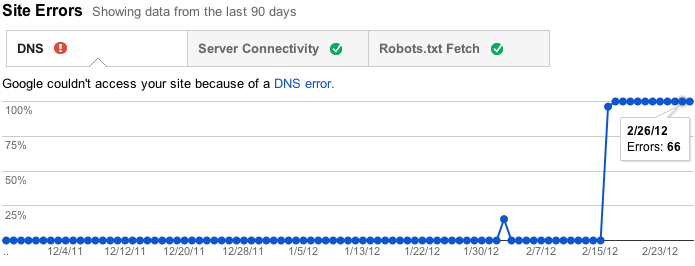 |
| View site error rate and counts over time |
Furthermore, if you don’t have (and haven’t recently had) any problems in these areas, as is the case for many sites, we won’t bother you with this section. Instead, we’ll just show you some friendly check marks to let you know everything is hunky-dory.
 |
| A site with no recent site-level errors |
URL errors
URL errors are errors that are specific to a particular page. This means that when Googlebot tried to crawl the URL, it was able to resolve your DNS, connect to your server, fetch and read your robots.txt file, and then request this URL, but something went wrong after that. We break the URL errors down into various categories based on what caused the error. If your site serves up Google News or mobile (CHTML/XHTML) data, we’ll show separate categories for those errors. |
| URL errors by type with full current and historical counts |
Less is more
We used to show you at most 100,000 errors of each type. Trying to consume all this information was like drinking from a firehose, and you had no way of knowing which of those errors were important (your homepage is down) or less important (someone’s personal site made a typo in a link to your site). There was no realistic way to view all 100,000 errors—no way to sort, search, or mark your progress. In the new version of this feature, we’ve focused on trying to give you only the most important errors up front. For each category, we’ll give you what we think are the 1000 most important and actionable errors. You can sort and filter these top 1000 errors, let us know when you think you’ve fixed them, and view details about them.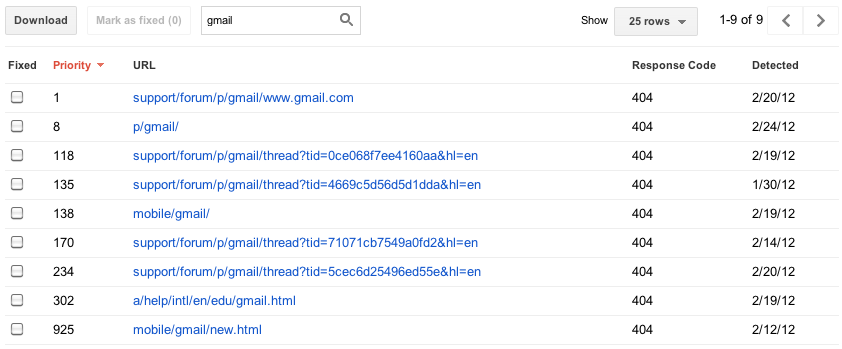 |
| Instantly filter and sort errors on any column |
Some sites have more than 1000 errors of a given type, so you’ll still be able to see the total number of errors you have of each type, as well as a graph showing historical data going back 90 days. For those who worry that 1000 error details plus a total aggregate count will not be enough, we’re considering adding programmatic access (an API) to allow you to download every last error you have, so please give us feedback if you need more.
We've also removed the list of pages blocked by robots.txt, because while these can sometimes be useful for diagnosing a problem with your robots.txt file, they are frequently pages you intentionally blocked. We really wanted to focus on errors, so look for information about roboted URLs to show up soon in the "Crawler access" feature under "Site configuration".
Dive into the details
Clicking on an individual error URL from the main list brings up a detail pane with additional information, including when we last tried to crawl the URL, when we first noticed a problem, and a brief explanation of the error. |
| Details for each URL error |
From the details pane you can click on the link for the URL that caused the error to see for yourself what happens when you try to visit it. You can also mark the error as “fixed” (more on that later!), view help content for the error type, list Sitemaps that contain the URL, see other pages that link to this URL, and even have Googlebot fetch the URL right now, either for more information or to double-check that your fix worked.
 |
| View pages which link to this URL |
Take action!
One thing we’re really excited about in this new version of the Crawl errors feature is that you can really focus on fixing what’s most important first. We’ve ranked the errors so that those at the top of the priority list will be ones where there’s something you can do, whether that’s fixing broken links on your own site, fixing bugs in your server software, updating your Sitemaps to prune dead URLs, or adding a 301 redirect to get users to the “real” page. We determine this based on a multitude of factors, including whether or not you included the URL in a Sitemap, how many places it’s linked from (and if any of those are also on your site), and whether the URL has gotten any traffic recently from search.Once you think you’ve fixed the issue (you can test your fix by fetching the URL as Googlebot), you can let us know by marking the error as “fixed” if you are a user with full access permissions. This will remove the error from your list. In the future, the errors you’ve marked as fixed won’t be included in the top errors list, unless we’ve encountered the same error when trying to re-crawl a URL.
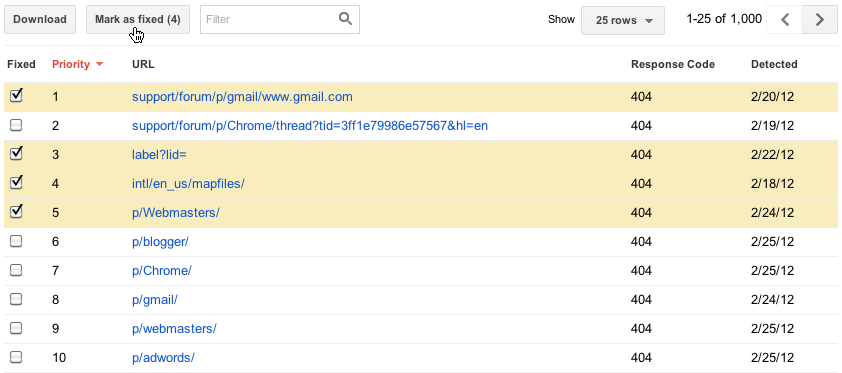 |
| Select errors and mark them as fixed |
We’ve put a lot of work into the new Crawl errors feature, so we hope that it will be very useful to you. Let us know what you think and if you have any suggestions, please visit our forum!


Video about pagination with rel=“next” and rel=“prev”
If you’re curious about the rel=”next” and rel=prev” for paginated content announcement we made several months ago, we filmed a video covering more of the basics of pagination to help answer your questions. Paginated content includes things like an article that spans several URLs/pages, or an e-commerce product category that spans multiple pages. With rel=”next” and rel=”prev” markup, you can provide a strong hint to Google that you would like us to treat these pages as a logical sequence, thus consolidating their linking properties and usually sending searchers to the first page. Feel free to check out our presentation for more information:
This video on pagination covers the basics of rel=”next” and rel=”prev” and how it could be useful for your site.
Slides from the pagination video
Additional resources about pagination include:
- Webmaster Central Blog post announcing support of rel=”next” and rel=”prev”
- Webmaster Help Center article with more implementations of rel=”next” and rel=”prev”
- Webmaster Forum thread with our answers to the community’s in-depth questions, such as:
Does rel=next/prev also work as a signal for only one page of the series (page 1 in most cases?) to be included in the search index? Or would noindex tags need to be present on page 2 and on?
When you implement rel="next" and rel="prev" on component pages of a series, we'll then consolidate the indexing properties from the component pages and attempt to direct users to the most relevant page/URL. This is typically the first page. There's no need to mark page 2 to n of the series with noindex unless you're sure that you don't want those pages to appear in search results.
Should I use the rel next/prev into [sic] the section of a blog even if the two contents are not strictly correlated (but they are just time-sequential)?
In regard to using rel=”next” and rel=”prev” for entries in your blog that “are not strictly correlated (but they are just time-sequential),” pagination markup likely isn’t the best use of your time -- time-sequential pages aren’t nearly as helpful to our indexing process as semantically related content, such as pagination on component pages in an article or category. It’s fine if you include the markup on your time-sequential pages, but please note that it’s not the most helpful use case.
We operate a real estate rental website. Our files display results based on numerous parameters that affect the order and the specific results that display. Examples of such parameters are “page number”, “records per page”, “sorting” and “area selection”...
It sounds like your real estate rental site encounters many of the same issues that e-commerce sites face... Here are some ideas on your situation:
1. It’s great that you are using the Webmaster Tools URL parameters feature to more efficiently crawl your site.
2. It’s possible that your site can form a rel=”next” and rel=”prev” sequence with no parameters (or with default parameter values). It’s also possible to form parallel pagination sequences when users select certain parameters, such as a sequence of pages where there are 15 records and a separate sequence when a user selects 30 records. Paginating component pages, even with parameters, helps us more accurately index your content.
3. While it’s fine to set rel=”canonical” from a component URL to a single view-all page, setting the canonical to the first page of a parameter-less sequence is considered improper usage. We make no promises to honor this implementation of rel=”canonical.”
Remember that if you have paginated content, it’s fine to leave it as-is and not add rel=”next” and rel=”prev” markup at all. But if you’re interested in pagination markup as a strong hint for us to better understand your site, we hope these resources help answer your questions!


Here's How to Find Out who Is The Owner Of any Phone
Have you ever been curious to know who owned a particular phone number? There's many times when you notice a phone number on our call display that we don't know and we aren't sure who is calling. To discover who owns the phone, you need to use what is known as a reverse phone lookup.
The tricky part can be finding information for mobile phones or numbers that aren't listed. Typically, you can easily find databases that store info for the numbers in the phone book. However, for cell phones or unlisted numbers you have to utilize a cell phone reverse lookup. To do this, look for specific companies that buy and compile phone records from people and companies so that they can to put together databases containing info for ANY phone.
As you can imagine, the internet has made this extremely simple to do. Nowadays, you just have to visit a website, type in the phone number, and the details about who owns the phone will be instantly shown on your screen.
I find it interesting to see how much information you can uncover about someone simply by having their phone number. Obviously you will find out their name, but you will also retrieve where they live, previous addresses and other interesting background info.
If you are hoping for detailed info on the owner or are searching for information on a cell phone or unlisted number, you will have to use a fee-based service. These are inexpensive though - just find a company that bills you a one-time membership fee that allows you to run as many lookups as you want.
Using a reverse phone lookup is extraordinarily to do and is the perfect way to discover out exactly the owner of any phone number you are wondering about.
Is There A Way That You Can Apprehend Your Prankster Who's Calling You In The Middle of The Night?
Receiving a lot of prank calls from mystery callers and hearing them shouting obscenities at you or something like that is one of the biggest problems any cell phone user has. It’s a good thing if you know the person or it’s just a friend who has nothing to do except make some practical jokes. Now what if the caller is someone you don’t have any idea and he’s even yelling threats at you? You don’t have to be alarmed for there is good news. There is a way to check who’s calling you and it’s this “Reverse Phone Detective” and it’s getting popular today. There are numerous websites offering this kind of service which you can take advantage of but there is no entirely-free cell phone lookup service. The only free phone number lookup are for landlines that can give you complete information. If you want to avail of this service on your cell phone, you can try this site or better yet, to know whether this is the “real” thing in turning the tables against your pranksters, you need to go first to some Reverse Phone Detective reviews site and from there, you will read an actual testimony from someone who have availed of the service of this phone number reverse lookup service and he will tell you all the benefits that he had gotten from it.
So, how does it work? For a very small charge, you can get a unabridged data of your caller who is constantly provoking you or giving you threats from an end of the line, from his or her name to her SSS number and something like that. Once you have gotten the required information, you can contact the proper authorities and they will take care of everything and it’s all because of a reverse phone detective.
So, how about it? What can you say? If you still don’t know what to do, once again, the most highly recommended thing to do is to go to this Reverse Phone Detective reviewsite and gather more information on how this phone reverse lookup service can give you benefits and how it can work for you and give you the peace of mind that you have always dreamed about with regards to cellphone usage.
Here's the simple way to find out exactly who owns any telephone number by using a reverse phone number lookup
A reverse phone search is a great tool that lets you discover who owns a phone by punching in the phone number. It's a great tool to use when you want to find out information about a phone number.
There are lots of reasons you may want to use a reverse phone lookup. You might be getting crank calls, or you see an unfamiliar number on your call display. Even people who are curious if their spouse is cheating, use this service to find out more about numbers they find on their spouse's mobile phone.
You can find out about cell phone numbers and unlisted numbers as well. These lookups are often called a cell phone reverse look up. Some organizations have set up businesses that allow them to put together massive databases of information on just about every phone number out there.
While there's a fee for a reverse phone lookup, it's inexpensive. However, there is something you can try to get this information free of charge!
It's easy. Go to Google and punch in the phone number you want to get information on. Make sure to enclose it in quotation marks, then hit the search key.
This works because sometimes the phone number may have been published online at one time or another. If the person put up classified ads online or completed a profile page on a site with their phone number, Google should be able to dig it up.
Of course, not every phone number is found by Google, so a paid service will come in handy otherwise. This will give you the full name and address of the person you're looking for, and may include important background details.
You are best to use a company that offers unlimited reverse phone searches for a one time only membership fee. Using this membership option lets you log in whenever you wish and run a search.
A reverse phone number search is an excellent tool to keep in mind, and they'll come in handy under many circumstances.
7 Temmuz 2012 Cumartesi
Upcoming changes in Google’s HTTP Referrer
Protecting users’ privacy is a priority for us and it’s helped drive recent changes. Helping users save time is also very important; it’s explicitly mentioned as a part of our philosophy. Today, we’re happy to announce that Google Web Search will soon be using a new proposal to reduce latency when a user of Google’s SSL-search clicks on a search result with a modern browser such as Chrome.
Starting in April, for browsers with the appropriate support, we will be using the "referrer" meta tag to automatically simplify the referring URL that is sent by the browser when visiting a page linked from an organic search result. This results in a faster time to result and more streamlined experience for the user.
What does this mean for sites that receive clicks from Google search results? You may start to see "origin" referrers—Google’s homepages (see the meta referrer specification for further detail)—as a source of organic SSL search traffic. This change will only affect the subset of SSL search referrers which already didn’t include the query terms. Non-HTTPS referrals will continue to behave as they do today. Again, the primary motivation for this change is to remove an unneeded redirect so that signed-in users reach their destination faster.
Website analytics programs can detect these organic search requests by detecting bare Google host names using SSL (like "https://www.google.co.uk/"). Webmasters will continue see the same data in Webmasters Tools—just as before, you’ll receive an aggregated list of the top search queries that drove traffic to their site.
We will continue to look into further improvements to how search query data is surfaced through Webmaster Tools. If you have questions, feedback or suggestions, please let us know through the Webmaster Tools Help Forum.


Five common SEO mistakes (and six good ideas!)
To help you avoid common mistakes webmasters face with regard to search engine optimization (SEO), I filmed a video outlining five common mistakes I’ve noticed in the SEO industry. Almost four years ago, we also gathered information from all of you (our readers) about your SEO recommendations and updated our related Help Center article given your feedback. Much of the same advice from 2008 still holds true today -- here’s to more years ahead building a great site!
If you’re short on time, here’s the gist:
Avoid these common mistakes
1. Having no value proposition: Try not to assume that a site should rank #1 without knowing why it’s helpful to searchers (and better than the competition :)Six fundamental SEO tips
2. Segmented approach: Be wary of setting SEO-related goals without making sure they’re aligned with your company’s overall objectives and the goals of other departments. For example, in tandem with your work optimizing product pages (and the full user experience once they come to your site), also contribute your expertise to your Marketing team’s upcoming campaign. So if Marketing is launching new videos or a more interactive site, be sure that searchers can find their content, too.
3. Time-consuming workarounds: Avoid implementing a hack rather than researching new features or best practices that could simplify development (e.g., changing the timestamp on an updated URL so it’s crawled more quickly instead of easily submitting the URL through Fetch as Googlebot).
4. Caught in SEO trends: Consider spending less time obsessing about the latest “trick” to boost your rankings and instead focus on the fundamental tasks/efforts that will bring lasting visitors.
5. Slow iteration: Aim to be agile rather than promote an environment where the infrastructure and/or processes make improving your site, or even testing possible improvements, difficult.
1. Do something cool: Make sure your site stands out from the competition -- in a good way!Good luck to everyone!
2. Include relevant words in your copy: Try to put yourself in the shoes of searchers. What would they query to find you? Your name/business name, location, products, etc., are important. It's also helpful to use the same terms in your site that your users might type (e.g., you might be a trained “flower designer” but most searchers might type [florist]), and to answer the questions they might have (e.g., store hours, product specs, reviews). It helps to know your customers.
3. Be smart about your tags and site architecture: Create unique title tags and meta descriptions; include Rich Snippets markup from schema.org where appropriate. Have intuitive navigation and good internal links.
4. Sign up for email forwarding in Webmaster Tools: Help us communicate with you, especially when we notice something awry with your site.
5. Attract buzz: Natural links, +1s, likes, follows... In every business there's something compelling, interesting, entertaining, or surprising that you can offer or share with your users. Provide a helpful service, tell fun stories, paint a vivid picture and users will share and reshare your content.
6. Stay fresh and relevant: Keep content up-to-date and consider options such as building a social media presence (if that’s where a potential audience exists) or creating an ideal mobile experience if your users are often on-the-go.


Updates to rich snippets
Today we’re announcing two updates to rich snippets.
First, we’re happy to announce that product rich snippets, which previously were only available in a limited set of locales, are supported globally. Users viewing your site’s results in Google search can now preview information about products available on your website, regardless of where they’re searching from. Here’s an example of a product rich snippet:
 |
| A product rich snippet from www.google.fr |
 |
| Preview rich snippets from HTML source |


Another step to reward high-quality sites
Google has said before that search engine optimization, or SEO, can be positive and constructive—and we're not the only ones. Effective search engine optimization can make a site more crawlable and make individual pages more accessible and easier to find. Search engine optimization includes things as simple as keyword research to ensure that the right words are on the page, not just industry jargon that normal people will never type.
“White hat” search engine optimizers often improve the usability of a site, help create great content, or make sites faster, which is good for both users and search engines. Good search engine optimization can also mean good marketing: thinking about creative ways to make a site more compelling, which can help with search engines as well as social media. The net result of making a great site is often greater awareness of that site on the web, which can translate into more people linking to or visiting a site.
The opposite of “white hat” SEO is something called “black hat webspam” (we say “webspam” to distinguish it from email spam). In the pursuit of higher rankings or traffic, a few sites use techniques that don’t benefit users, where the intent is to look for shortcuts or loopholes that would rank pages higher than they deserve to be ranked. We see all sorts of webspam techniques every day, from keyword stuffing to link schemes that attempt to propel sites higher in rankings.
The goal of many of our ranking changes is to help searchers find sites that provide a great user experience and fulfill their information needs. We also want the “good guys” making great sites for users, not just algorithms, to see their effort rewarded. To that end we’ve launched Panda changes that successfully returned higher-quality sites in search results. And earlier this year we launched a page layout algorithm that reduces rankings for sites that don’t make much content available “above the fold.”
In the next few days, we’re launching an important algorithm change targeted at webspam. The change will decrease rankings for sites that we believe are violating Google’s existing quality guidelines. We’ve always targeted webspam in our rankings, and this algorithm represents another improvement in our efforts to reduce webspam and promote high quality content. While we can't divulge specific signals because we don't want to give people a way to game our search results and worsen the experience for users, our advice for webmasters is to focus on creating high quality sites that create a good user experience and employ white hat SEO methods instead of engaging in aggressive webspam tactics.
Here’s an example of a webspam tactic like keyword stuffing taken from a site that will be affected by this change:

Of course, most sites affected by this change aren’t so blatant. Here’s an example of a site with unusual linking patterns that is also affected by this change. Notice that if you try to read the text aloud you’ll discover that the outgoing links are completely unrelated to the actual content, and in fact the page text has been “spun” beyond recognition:

Sites affected by this change might not be easily recognizable as spamming without deep analysis or expertise, but the common thread is that these sites are doing much more than white hat SEO; we believe they are engaging in webspam tactics to manipulate search engine rankings.
The change will go live for all languages at the same time. For context, the initial Panda change affected about 12% of queries to a significant degree; this algorithm affects about 3.1% of queries in English to a degree that a regular user might notice. The change affects roughly 3% of queries in languages such as German, Chinese, and Arabic, but the impact is higher in more heavily-spammed languages. For example, 5% of Polish queries change to a degree that a regular user might notice.
We want people doing white hat search engine optimization (or even no search engine optimization at all) to be free to focus on creating amazing, compelling web sites. As always, we’ll keep our ears open for feedback on ways to iterate and improve our ranking algorithms toward that goal.


Webmaster Tools spring cleaning
Webmaster Tools added lots of new functionality over the past year, such as improvements to Sitemaps and Crawl errors, as well as the new User Administration feature. In recent weeks, we also updated the look & feel of our user interface to match Google's new style. In order to keep bringing you improvements, we occasionally review each of our features to see if they’re still useful in comparison to the maintenance and support they require. As a result of our latest round of spring cleaning, we'll be removing the Subscriber stats feature, the Create robots.txt tool, and the Site performance feature in the next two weeks.
Subscriber stats reports the number of subscribers to a site’s RSS or Atom feeds. This functionality is currently provided in Feedburner, another Google product which offers its own subscriber stats as well as other cool features specifically geared for feeds of all types. If you are looking for a replacement to Subscriber stats in Webmaster Tools, check out Feedburner.
The Create robots.txt tool provides a way to generate robots.txt files for the purpose of blocking specific parts of a site from being crawled by Googlebot. This feature has very low usage, so we've decided to remove it from Webmaster Tools. While many websites don't even need a robots.txt file, if you feel that you do need one, it's easy to make one yourself in a text editor or use one of the many other tools available on the web for generating robots.txt files.
Site performance is a Webmaster Tools Labs feature that provides information about the average load time of your site's pages. This feature is also being removed due to low usage. Now you might have heard our announcement from a couple of years ago that the latency of a site's pages is a factor in our search ranking algorithms. This is still true, and you can analyze your site's performance using the Site Speed feature in Google Analytics or using Google's PageSpeed online. There are also many other site performance analysis tools available like WebPageTest and the YSlow browser plugin.
If you have questions or comments about these changes please post them in our Help Forum.


5 Temmuz 2012 Perşembe
Adding associates to manage your YouTube presence
Many organizations have multiple presences on the web. For example, Webmaster Tools lives at www.google.com/webmasters, but it also has a Twitter account and a YouTube channel. It's important that visitors to these other properties have confidence that they are actually associated with the Webmaster Tools site. However to date it has been challenging for webmasters to manage which users can take actions on behalf of their site in different services.
Today we're happy to announce a new feature in Webmaster Tools that allows webmasters to add "associates" -- trusted users who can act on behalf of your site in other Google products. Unlike site owners and users, associates can't view site data or take any site actions in Webmaster Tools, but they are authorized to perform specific tasks in other products.
For this initial launch, members of YouTube's partner program that have created a YouTube channel for their site can now link the two together. By doing this, your YouTube channel will be displayed as the "official channel" for your website.

Management within Webmaster Tools
To add or change associates:
- On the Webmaster Tools home page, click the site you want.
- Under Configuration, click Associates.
- Click Add a new associate.
- In the text box, type the email address of the person you want to add.
- Select the type of association you want.
- Click Add.


Management within YouTube
It’s also possible for users to request association from a site’s webmaster.- Log in to your YouTube partner account.
- Click on the user menu and choose Settings > Associated Website.
- Fill in the page you would like to associate your channel with.
- Click Add. If you’re a verified owner of the site, you’re done. But if someone else in your organization manages the website, the association will be marked Pending. The owner receives a notification with an option to approve or deny the request.
- After approval is granted, navigate back to this page and click Refresh to complete the association.


If you have more questions, please see the Help with Associates article or visit our webmaster help forum.


Here's How to Find Out who Is The Owner Of any Phone
Have you ever been curious to know who owned a particular phone number? There's many times when you notice a phone number on our call display that we don't know and we aren't sure who is calling. To discover who owns the phone, you need to use what is known as a reverse phone lookup.
The tricky part can be finding information for mobile phones or numbers that aren't listed. Typically, you can easily find databases that store info for the numbers in the phone book. However, for cell phones or unlisted numbers you have to utilize a cell phone reverse lookup. To do this, look for specific companies that buy and compile phone records from people and companies so that they can to put together databases containing info for ANY phone.
As you can imagine, the internet has made this extremely simple to do. Nowadays, you just have to visit a website, type in the phone number, and the details about who owns the phone will be instantly shown on your screen.
I find it interesting to see how much information you can uncover about someone simply by having their phone number. Obviously you will find out their name, but you will also retrieve where they live, previous addresses and other interesting background info.
If you are hoping for detailed info on the owner or are searching for information on a cell phone or unlisted number, you will have to use a fee-based service. These are inexpensive though - just find a company that bills you a one-time membership fee that allows you to run as many lookups as you want.
Using a reverse phone lookup is extraordinarily to do and is the perfect way to discover out exactly the owner of any phone number you are wondering about.
Is There A Way That You Can Apprehend Your Prankster Who's Calling You In The Middle of The Night?
Receiving a lot of prank calls from mystery callers and hearing them shouting obscenities at you or something like that is one of the biggest problems any cell phone user has. It’s a good thing if you know the person or it’s just a friend who has nothing to do except make some practical jokes. Now what if the caller is someone you don’t have any idea and he’s even yelling threats at you? You don’t have to be alarmed for there is good news. There is a way to check who’s calling you and it’s this “Reverse Phone Detective” and it’s getting popular today. There are numerous websites offering this kind of service which you can take advantage of but there is no entirely-free cell phone lookup service. The only free phone number lookup are for landlines that can give you complete information. If you want to avail of this service on your cell phone, you can try this site or better yet, to know whether this is the “real” thing in turning the tables against your pranksters, you need to go first to some Reverse Phone Detective reviews site and from there, you will read an actual testimony from someone who have availed of the service of this phone number reverse lookup service and he will tell you all the benefits that he had gotten from it.
So, how does it work? For a very small charge, you can get a unabridged data of your caller who is constantly provoking you or giving you threats from an end of the line, from his or her name to her SSS number and something like that. Once you have gotten the required information, you can contact the proper authorities and they will take care of everything and it’s all because of a reverse phone detective.
So, how about it? What can you say? If you still don’t know what to do, once again, the most highly recommended thing to do is to go to this Reverse Phone Detective reviewsite and gather more information on how this phone reverse lookup service can give you benefits and how it can work for you and give you the peace of mind that you have always dreamed about with regards to cellphone usage.
Here's the simple way to find out exactly who owns any telephone number by using a reverse phone number lookup
A reverse phone search is a great tool that lets you discover who owns a phone by punching in the phone number. It's a great tool to use when you want to find out information about a phone number.
There are lots of reasons you may want to use a reverse phone lookup. You might be getting crank calls, or you see an unfamiliar number on your call display. Even people who are curious if their spouse is cheating, use this service to find out more about numbers they find on their spouse's mobile phone.
You can find out about cell phone numbers and unlisted numbers as well. These lookups are often called a cell phone reverse look up. Some organizations have set up businesses that allow them to put together massive databases of information on just about every phone number out there.
While there's a fee for a reverse phone lookup, it's inexpensive. However, there is something you can try to get this information free of charge!
It's easy. Go to Google and punch in the phone number you want to get information on. Make sure to enclose it in quotation marks, then hit the search key.
This works because sometimes the phone number may have been published online at one time or another. If the person put up classified ads online or completed a profile page on a site with their phone number, Google should be able to dig it up.
Of course, not every phone number is found by Google, so a paid service will come in handy otherwise. This will give you the full name and address of the person you're looking for, and may include important background details.
You are best to use a company that offers unlimited reverse phone searches for a one time only membership fee. Using this membership option lets you log in whenever you wish and run a search.
A reverse phone number search is an excellent tool to keep in mind, and they'll come in handy under many circumstances.
How to Opt Out of Yahoo's Reverse Phone Directory
 If you are worried regarding identity thieves or stalkers obtaining your personal info from Yahoo's reverse phonephone directory, you'll opt out of the web listing to safeguard your privacy.
The data in Yahoo's reverse phonephone listings come back from a third-party supplier referred to as Intelius, that gathers phonephone, address and email information from white pages and phone books, moreover as different sources. If your variety is not listed in your native phonephone directory, you most likely are not listed in Yahoo's reverse directory. However, you'll still submit an opt-out request as a precautionary live.
Instructions
1. attend Yahoo's on-line removal request type (see Resources section).
2. Complete the shape by coming into your initial and last name, city, state, nothing code and phone variety or street address. If you embody your phone variety on the shape, your street address is not necessary, and vice versa; you merely ought to list one in all them to opt out.
3. choose "General Privacy Concerns" because the reason for removal.
4. Click the "Remove Me" button to submit the removal type.
5. Wait a minimum of one business day to permit Yahoo to method your removal request.